Diseño de un observador de la farmacocinética mediante la inversión de la farmacodinámica en anestesia general intravenosa
DOI:
https://doi.org/10.17488/RMIB.46.3.1503Palabras clave:
BIS, NOX, Observador, Anestesia General, Farmacocinética-FarmacodinámicaResumen
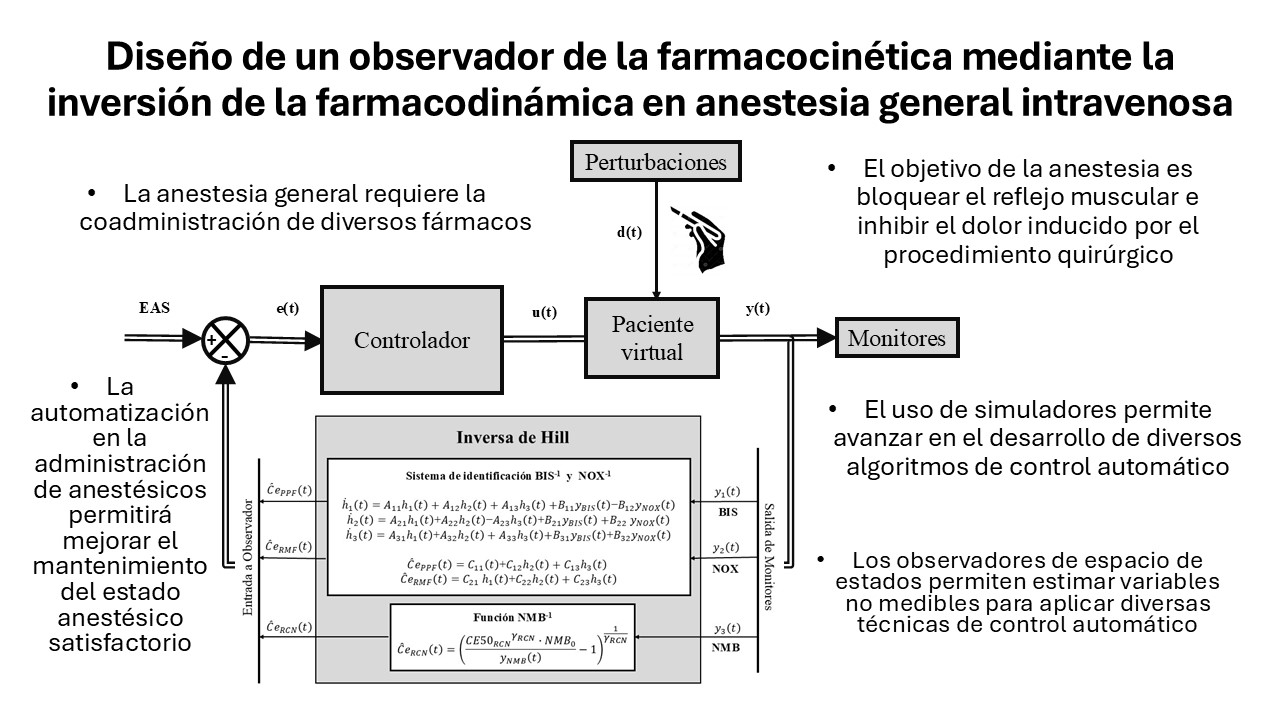
En el presente trabajo se prueba la viabilidad de un observador en estados aplicado a una cohorte de pacientes virtuales en un simulador desarrollado en Matlab-Simulink. El modelado de los pacientes virtuales se puede dividir en una parte lineal, denominada como farmacocinética, y una parte no lineal, formada por la farmacodinámica. El observador en espacio de estados debe estimar las variables de estado, o masas en los compartimentos correspondientes a la farmacocinética de los fármacos Propofol y Remifentanilo; así también se integra un observador para las variables de estado de la farmacocinética del Rocuronio a fin de hacer todas las variables disponibles para el diseño e implementación de algoritmos de control basados en la realimentación de las variables de estados para la coadministración de los fármacos. Para completar el esquema de estimación de las variables que conforman el modelado matemático de los pacientes virtuales se integra una aproximación de las funciones inversas de los elementos no lineales que modelan la farmacodinámica; dicha aproximación es obtenida con el System Identification Toolbox. El esquema propuesto y los resultados obtenidos demuestran su viabilidad y abren el panorama para futuros desarrollos en el control de sistemas de anestesia.
Descargas
Citas
B. Rodríguez Borreguero, “Diseño de un modelo de paciente virtual en anestesia general,” Proyecto Fin de Carrera, Grado en Ingeniería de Sistemas de Telecomunicación, Dept. Ingeniería Telemática y Electrónica, E.T.S.I. y Sistemas de Telecomunicación, Univ. Politécnica de Madrid, Feb. 2021. [Online]. Available: https://oa.upm.es/69443/.
T. W. Schnider, C. F. Minto, P. L. Gambus, C. Andresen, D. B. Goodale, S. L. Shafer, and E. J. Youngs, “The influence of method of administration and covariates on the pharmacokinetics of propofol in adult volunteers,” *J. Am. Soc. Anesthesiol.*, vol. 88, no. 5, pp. 1170–1182, May 1998, DOI: https:// doi.org/10.1097/00000542-199805000-00006.
Minto, C. F., Schnider, T. W., Egan, T. D., Youngs, E., LEMMENS, H. M., Gambus, P. L., ... & Rich, G. F. (1997). Influence of age and gender on the pharmacokinetics and pharmacodynamics of remifentanil: I. Model development. Survey of Anesthesiology, 41(6), 337.
J. Almeida, T. Mendonça, and P. Rocha, “A simple positive control law for the rocuronium-induced neuromuscular blockade level,” *IFACPapersOnLine*, vol. 51, no. 4, pp. 90–94, 2018, DOI: https://doi.org/10.1016/j.ifacol.2018.06.040.
M. Schiavo, F. Padula, N. Latronico, M. Paltenghi, and A. Visioli, “Optimized PID controller for propofol and remifentanil coadministration: Influence of opioid-hypnotic balance,” *IFAC-PapersOnLine*, vol. 54, no. 15, pp. 13–18, 2021, DOI: https://doi.org/10.1016/j.ifacol.2021.10.224.
Luginbuehl, M., Schumacher, P. M., Vuilleumier, P., Vereecke, H., Heyse, B., Bouillon, T. W., & Struys, M. M. (2010). Noxious stimulation response index: a novel anesthetic state index based on hypnotic–opioid interaction. The Journal of the American Society of Anesthesiologists, 112(4), 872-880.
M. M. da Silva, T. Wigren, and T. Mendonça, “Nonlinear identification of a minimal neuromuscular blockade model in anesthesia,” *IEEE Trans. Control Syst. Technol.*, vol. 20, no. 1, pp. 181–188, Jan. 2011, DOI: 10.1109/TCST.2011.2107742.
Castañeda, C. E., Orozco-López, O., Abad-Gurumeta, A., Hernando, M. E., & Rodríguez-Herrero, A. (2023). Personalized asymmetric multiple PID to automatize the procedure of intravenous general anesthesia. Journal of Process Control, 128, 103019.
L. Merigo, M. Beschi, F. Padula, N. Latronico, M. Paltenghi, and A. Visioli, “Event-based control of propofol and remifentanil coadministration during clinical anesthesia,” in *2017 3rd International Conference on Event-Based Control, Communication and Signal Processing (EBCCSP)*, May 2017, pp. 1–8, DOI: 10.1109/TCST.2011.2107742.
Dávila-Cervantes, A. (2014). Simulación en educación médica. Investigación en educación médica, 3(10), 100-105.
Pawłowski, A., Schiavo, M., Latronico, N., Paltenghi, M., & Visioli, A. (2022). Model predictive control using MISO approach for drug co- administration in anesthesia. Journal of Process Control, 117, 98-111.
Pawłowski, A., Schiavo, M., Latronico, N., Paltenghi, M., & Visioli, A. (2023). Event-based MPC for propofol administration in anesthesia. Computer Methods and Programs in Biomedicine, 229, 107289.
Maxim, A., & Copot, D. (2021). Closed-loop control of anesthesia and hemodynamic system: a model predictive control approach. IFAC-PapersOnLine, 54(15), 37-42.
C. M. Ionescu, “Open Source Patient Simulator,” MATLAB Central File Exchange, Nov. 14, 2024. [Online]. Available: https://www.mathworks.com/matlabcentral/fileexchange/85208-open-source-patient-simulator.
Ionescu, C. M., Neckebroek, M., Ghita, M., & Copot, D. (2021). An open source patient simulator for design and evaluation of computer based multiple drug dosing control for anesthetic and hemodynamic variables. IEEE Access, 9, 8680-8694.
Aubouin-Pairault, B., Dang, T., & Fiacchini, M. (2023). PAS: A Python Anesthesia Simulator for drug control. Journal of Open Source Software, 8(88), 5480.
J.-P. Haberer, “Principios de farmacocinética aplicados a la anestesia,” *EMC-Anestesia-Reanimación*, vol. 42, no. 3, pp. 1–15, 2016, DOI: https://doi.org/10.1016/S1280-4703(16)79272-3.
K. Ogata, Ingeniería de control moderna. Madrid, España: Pearson Educación, 2003. Accessed: Nov. 04, 2024. [Online]. Available: https://www.academia.edu/download/57733179/Ogatta_Ingenieria_de_control_moderna_5ta.pdf.
MathWorks, “System Identification Toolbox,” MathWorks, Inc. [Online]. Available: https://www.mathworks.com/products/sysid.html Accessed: Nov. 14, 2024.
Orozco-López, J. O., Castañeda, C. E., Rodríguez-Herrero, A., García-Sáez, G., & Hernando, E. (2018). Linear time-varying Luenberger observer applied to diabetes. IEEE Access, 6, 23612-23625.
Schiavo, M., Padula, F., Latronico, N., Paltenghi, M., & Visioli, A. (2023). Experimental results of an event-based PID control system for propofol and remifentanil coadministration. Control Engineering Practice, 131, 105384.
Paolino, N., Schiavo, M., Latronico, N., Paltenghi, M., & Visioli, A. (2024). PK/PD model based design of PID control for closed-loop anesthesia. IFAC Journal of Systems and Control, 27, 100247.
Schiavo, M., Padula, F., Latronico, N., Paltenghi, M., & Visioli, A. (2022). Individualized PID tuning for maintenance of general anesthesia with propofol and remifentanil coadministration. Journal of Process Control, 109, 74-82.
Hegedüs, E. T., Birs, I. R., Ionescu, C. M., & Muresan, C. I. (2024). A Novel Decentralized–Decoupled Fractional-Order Control Strategy for Complete Anesthesia–Hemodynamic Stabilization in Patients Undergoing Surgical Procedures. Fractal and Fractional, 8(11), 623.
Heynen, J., Copot, D., Ghita, M., & Ionescu, C. (2021, October). Using convolutional neural network online estimators for predicting pain-level variability enables predictive control of anesthesia. In 2021 25th International conference on system theory, control and computing (ICSTCC) (pp. 194-199). IEEE.
Aubouin-Pairault, B., Fiacchini, M., & Dang, T. (2024). Comparison of multiple Kalman filter and moving horizon estimator for the anesthesia process. Journal of Process Control, 136, 103179.
Descargas
Publicado
Cómo citar
Número
Sección
Licencia
Derechos de autor 2025 Revista Mexicana de Ingenieria Biomedica

Esta obra está bajo una licencia internacional Creative Commons Atribución-NoComercial 4.0.
Una vez que el artículo es aceptado para su publicación en la RMIB, se les solicitará al autor principal o de correspondencia que revisen y firman las cartas de cesión de derechos correspondientes para llevar a cabo la autorización para la publicación del artículo. En dicho documento se autoriza a la RMIB a publicar, en cualquier medio sin limitaciones y sin ningún costo. Los autores pueden reutilizar partes del artículo en otros documentos y reproducir parte o la totalidad para su uso personal siempre que se haga referencia bibliográfica al RMIB. No obstante, todo tipo de publicación fuera de las publicaciones académicas del autor correspondiente o para otro tipo de trabajos derivados y publicados necesitaran de un permiso escrito de la RMIB.