Design of a Pharmacokinetics Observer Through the Inversion of Pharmacodynamics in Intravenous General Anesthesia
DOI:
https://doi.org/10.17488/RMIB.46.3.1503Keywords:
BIS, NOX, Observador, General Anestesia, Pharmacokinetics-PharmacodynamicsAbstract
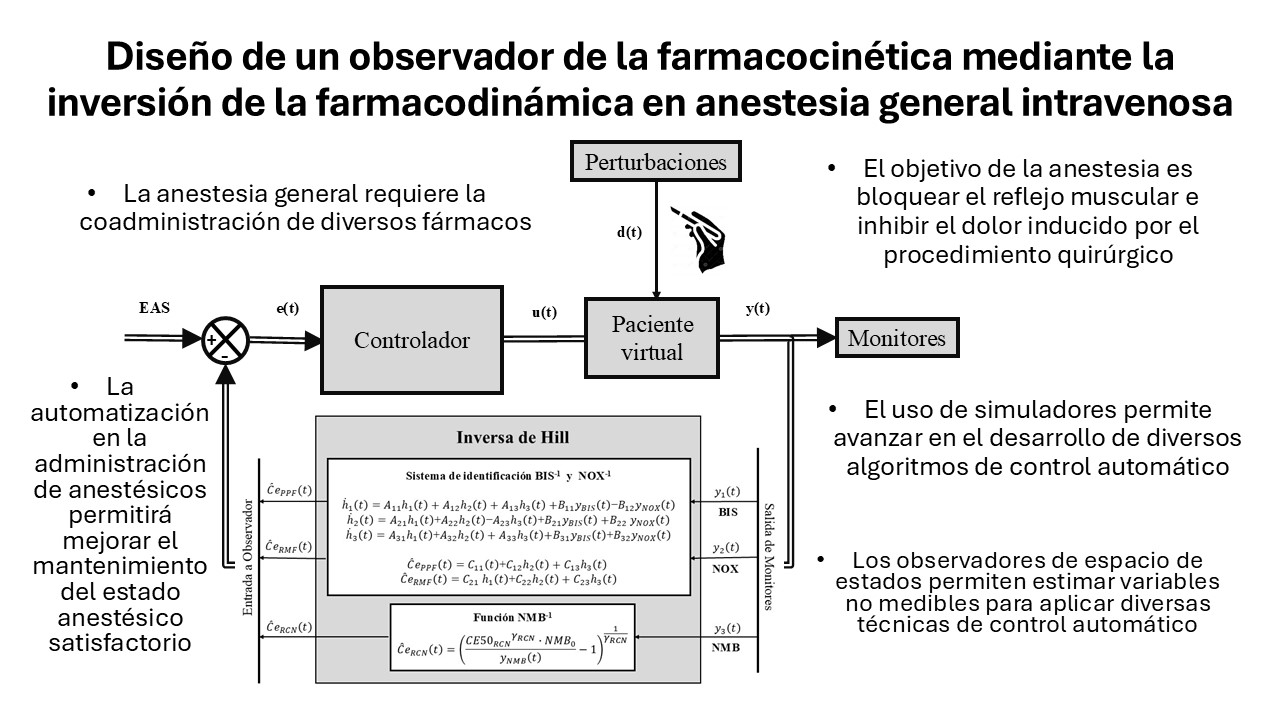
In this work, the feasibility of a state-space observer applied to a cohort of virtual patients in a simulator developed in Matlab-Simulink is tested. The modeling of virtual patients can be divided into a linear part, referred to as pharmacokinetics, and a nonlinear part, corresponding to pharmacodynamics. The state-space observer is designed to estimate the state variables, or masses in the compartments associated with the pharmacokinetics of the drugs Propofol and Remifentanil. Additionally, an observer for the state variables of the pharmacokinetics of Rocuronium is integrated to make all variables available for the design and implementation of control algorithms based on state variable feedback for the coadministration of the drugs. To complete the estimation scheme for the variables comprising the mathematical modeling of the virtual patients, an approximation of the inverse functions of the nonlinear elements modeling pharmacodynamics is included; this approximation is obtained using the System Identification Toolbox. The proposed scheme and the results obtained demonstrate its feasibility and open the door to future developments in the control of anesthesia systems.
Downloads
References
B. Rodríguez Borreguero, “Diseño de un modelo de paciente virtual en anestesia general,” Proyecto Fin de Carrera, Grado en Ingeniería de Sistemas de Telecomunicación, Dept. Ingeniería Telemática y Electrónica, E.T.S.I. y Sistemas de Telecomunicación, Univ. Politécnica de Madrid, Feb. 2021. [Online]. Available: https://oa.upm.es/69443/.
T. W. Schnider, C. F. Minto, P. L. Gambus, C. Andresen, D. B. Goodale, S. L. Shafer, and E. J. Youngs, “The influence of method of administration and covariates on the pharmacokinetics of propofol in adult volunteers,” *J. Am. Soc. Anesthesiol.*, vol. 88, no. 5, pp. 1170–1182, May 1998, DOI: https:// doi.org/10.1097/00000542-199805000-00006.
Minto, C. F., Schnider, T. W., Egan, T. D., Youngs, E., LEMMENS, H. M., Gambus, P. L., ... & Rich, G. F. (1997). Influence of age and gender on the pharmacokinetics and pharmacodynamics of remifentanil: I. Model development. Survey of Anesthesiology, 41(6), 337.
J. Almeida, T. Mendonça, and P. Rocha, “A simple positive control law for the rocuronium-induced neuromuscular blockade level,” *IFACPapersOnLine*, vol. 51, no. 4, pp. 90–94, 2018, DOI: https://doi.org/10.1016/j.ifacol.2018.06.040.
M. Schiavo, F. Padula, N. Latronico, M. Paltenghi, and A. Visioli, “Optimized PID controller for propofol and remifentanil coadministration: Influence of opioid-hypnotic balance,” *IFAC-PapersOnLine*, vol. 54, no. 15, pp. 13–18, 2021, DOI: https://doi.org/10.1016/j.ifacol.2021.10.224.
Luginbuehl, M., Schumacher, P. M., Vuilleumier, P., Vereecke, H., Heyse, B., Bouillon, T. W., & Struys, M. M. (2010). Noxious stimulation response index: a novel anesthetic state index based on hypnotic–opioid interaction. The Journal of the American Society of Anesthesiologists, 112(4), 872-880.
M. M. da Silva, T. Wigren, and T. Mendonça, “Nonlinear identification of a minimal neuromuscular blockade model in anesthesia,” *IEEE Trans. Control Syst. Technol.*, vol. 20, no. 1, pp. 181–188, Jan. 2011, DOI: 10.1109/TCST.2011.2107742.
Castañeda, C. E., Orozco-López, O., Abad-Gurumeta, A., Hernando, M. E., & Rodríguez-Herrero, A. (2023). Personalized asymmetric multiple PID to automatize the procedure of intravenous general anesthesia. Journal of Process Control, 128, 103019.
L. Merigo, M. Beschi, F. Padula, N. Latronico, M. Paltenghi, and A. Visioli, “Event-based control of propofol and remifentanil coadministration during clinical anesthesia,” in *2017 3rd International Conference on Event-Based Control, Communication and Signal Processing (EBCCSP)*, May 2017, pp. 1–8, DOI: 10.1109/TCST.2011.2107742.
Dávila-Cervantes, A. (2014). Simulación en educación médica. Investigación en educación médica, 3(10), 100-105.
Pawłowski, A., Schiavo, M., Latronico, N., Paltenghi, M., & Visioli, A. (2022). Model predictive control using MISO approach for drug co- administration in anesthesia. Journal of Process Control, 117, 98-111.
Pawłowski, A., Schiavo, M., Latronico, N., Paltenghi, M., & Visioli, A. (2023). Event-based MPC for propofol administration in anesthesia. Computer Methods and Programs in Biomedicine, 229, 107289.
Maxim, A., & Copot, D. (2021). Closed-loop control of anesthesia and hemodynamic system: a model predictive control approach. IFAC-PapersOnLine, 54(15), 37-42.
C. M. Ionescu, “Open Source Patient Simulator,” MATLAB Central File Exchange, Nov. 14, 2024. [Online]. Available: https://www.mathworks.com/matlabcentral/fileexchange/85208-open-source-patient-simulator.
Ionescu, C. M., Neckebroek, M., Ghita, M., & Copot, D. (2021). An open source patient simulator for design and evaluation of computer based multiple drug dosing control for anesthetic and hemodynamic variables. IEEE Access, 9, 8680-8694.
Aubouin-Pairault, B., Dang, T., & Fiacchini, M. (2023). PAS: A Python Anesthesia Simulator for drug control. Journal of Open Source Software, 8(88), 5480.
J.-P. Haberer, “Principios de farmacocinética aplicados a la anestesia,” *EMC-Anestesia-Reanimación*, vol. 42, no. 3, pp. 1–15, 2016, DOI: https://doi.org/10.1016/S1280-4703(16)79272-3.
K. Ogata, Ingeniería de control moderna. Madrid, España: Pearson Educación, 2003. Accessed: Nov. 04, 2024. [Online]. Available: https://www.academia.edu/download/57733179/Ogatta_Ingenieria_de_control_moderna_5ta.pdf.
MathWorks, “System Identification Toolbox,” MathWorks, Inc. [Online]. Available: https://www.mathworks.com/products/sysid.html Accessed: Nov. 14, 2024.
Orozco-López, J. O., Castañeda, C. E., Rodríguez-Herrero, A., García-Sáez, G., & Hernando, E. (2018). Linear time-varying Luenberger observer applied to diabetes. IEEE Access, 6, 23612-23625.
Schiavo, M., Padula, F., Latronico, N., Paltenghi, M., & Visioli, A. (2023). Experimental results of an event-based PID control system for propofol and remifentanil coadministration. Control Engineering Practice, 131, 105384.
Paolino, N., Schiavo, M., Latronico, N., Paltenghi, M., & Visioli, A. (2024). PK/PD model based design of PID control for closed-loop anesthesia. IFAC Journal of Systems and Control, 27, 100247.
Schiavo, M., Padula, F., Latronico, N., Paltenghi, M., & Visioli, A. (2022). Individualized PID tuning for maintenance of general anesthesia with propofol and remifentanil coadministration. Journal of Process Control, 109, 74-82.
Hegedüs, E. T., Birs, I. R., Ionescu, C. M., & Muresan, C. I. (2024). A Novel Decentralized–Decoupled Fractional-Order Control Strategy for Complete Anesthesia–Hemodynamic Stabilization in Patients Undergoing Surgical Procedures. Fractal and Fractional, 8(11), 623.
Heynen, J., Copot, D., Ghita, M., & Ionescu, C. (2021, October). Using convolutional neural network online estimators for predicting pain-level variability enables predictive control of anesthesia. In 2021 25th International conference on system theory, control and computing (ICSTCC) (pp. 194-199). IEEE.
Aubouin-Pairault, B., Fiacchini, M., & Dang, T. (2024). Comparison of multiple Kalman filter and moving horizon estimator for the anesthesia process. Journal of Process Control, 136, 103179.
Downloads
Published
How to Cite
Issue
Section
License
Copyright (c) 2025 Revista Mexicana de Ingenieria Biomedica

This work is licensed under a Creative Commons Attribution-NonCommercial 4.0 International License.
Upon acceptance of an article in the RMIB, corresponding authors will be asked to fulfill and sign the copyright and the journal publishing agreement, which will allow the RMIB authorization to publish this document in any media without limitations and without any cost. Authors may reuse parts of the paper in other documents and reproduce part or all of it for their personal use as long as a bibliographic reference is made to the RMIB. However written permission of the Publisher is required for resale or distribution outside the corresponding author institution and for all other derivative works, including compilations and translations.