Portable and Non-Invasive System for Gas Exchange Dynamics Estimation and Energy Expenditure as an Indicator of Metabolic State
DOI:
https://doi.org/10.17488/RMIB.46.3.1502Keywords:
dynamic modeling, energy expenditure, gas exchange estimation, non-invasive monitoring, wearable deviceAbstract
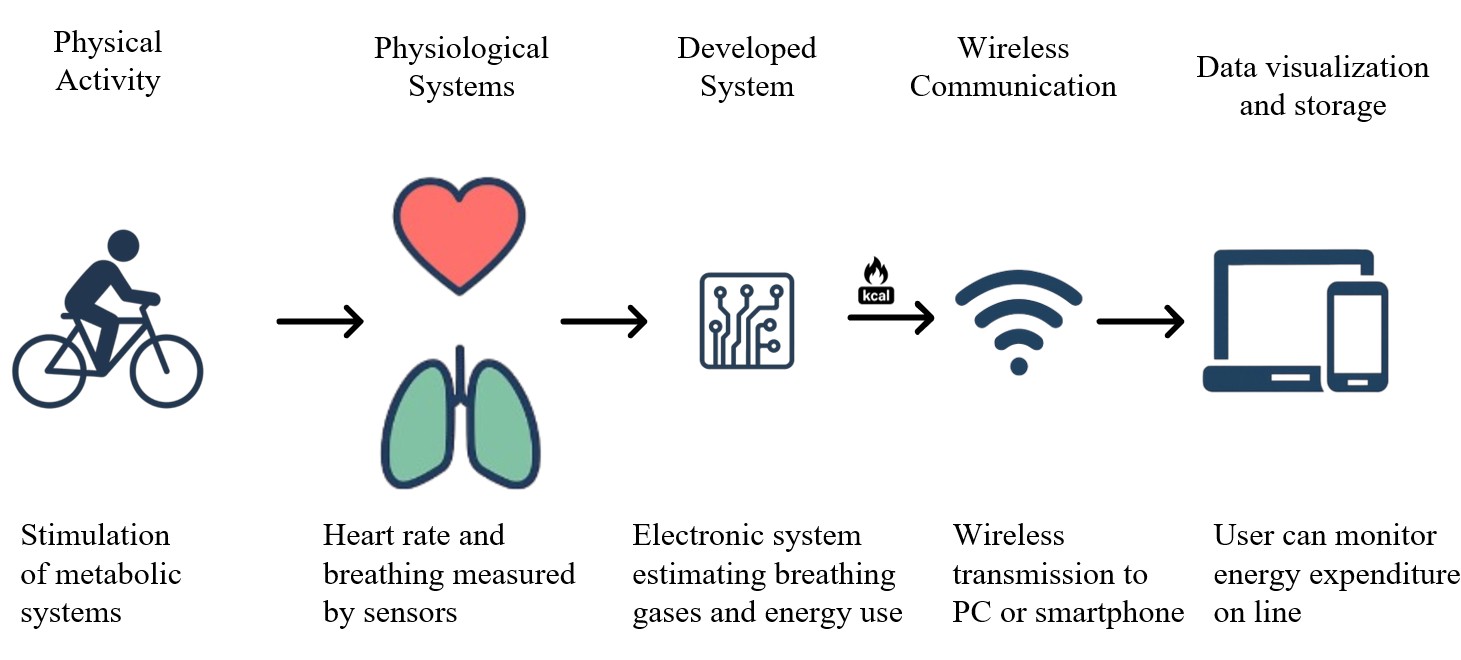
Accurate estimation of energy expenditure and gas exchange dynamics is essential for health monitoring and performance optimization. This study addresses the limitations of traditional systems by developing a portable, non-invasive, and real-time solution that correlates physiological signals with energy metabolism. The proposed system estimates energy expenditure and metabolic state using oxygen and carbon dioxide flows derived from non-invasive variables such as respiratory ventilation and heart rate. It utilizes Bluetooth Low Energy (BLE) for wireless communication and includes user-friendly interfaces for smartphones and computers to facilitate data visualization and recording. Calibration is performed using a calorimeter, resulting in an average estimation error of 14.83%. The system demonstrates reliable performance under various conditions, providing real-time estimations of energy expenditure and gas exchange. Its portability and ergonomic design improve usability; however, precise calibration remains essential, and broader testing is required to validate robustness. A key advantage of the system is its ability to operate entirely offline, relying solely on BLE for data transmission, making it suitable for real-time monitoring in diverse environments.
Downloads
References
“Energy sources,” Polar Global. Accessed: Jun. 12, 2022. [Online]. Available: https://support.polar.com/en/energy-nutrients.
“Frequently Asked Questions about Body Battery,” Garmin Support Center. Accessed: Jun. 12, 2022. [Online]. Available: https://support.garmin.com/
es-ES/?faq=VOFJAsiXut9K19k1qEn5W5.
“Cardio Pulmonary Exercise Test (CPET), accurate metabolic assessment,” COSMED. Accessed: Dec. 11, 2024. [Online]. Available: https://www.cosmed.
com/en/products/cardio-pulmonary-exercise-test.
G. Nazari, P. Bobos, J. C. MacDermid, K. E. Sinden, J. Richardson, and A. Tang, “Psychometric properties of the Zephyr bioharness device: A systematic
review,” Eur. Rev. Aging Phys. Act., vol. 15, no. 1, Feb. 2018, doi: https://doi.org/10.1186/s13102-018-0094-4.
N. Rosero, J. J. Martinez, and H. Leon, “A bio-energetic model of cyclist for enhancing pedelec systems,” IFAC-PapersOnLine, vol. 50, no. 1, pp. 4418–
, Jul. 2017, doi: https://doi.org/10.1016/j.ifacol.2017.08.918.
N. Rosero, J. J. Martinez, and M. Corno, “Modeling of gas exchange dynamics using cycle-ergometer tests,” IFAC-PapersOnLine, vol. 51, no. 2, pp.
–354, 2018, doi: https://doi.org/10.1016/j.ifacol.2018.03.060.
G. R. Alvarez, J. D. Chiza Ocana, J. M. Ramirez Scarpetta, E. E. Rosero Garcia, and C. A. Lopez Alban, “Instrumentation system for estimating the metabolic
state during the use of the bicycle as a means of transportation,” in Proceedings of the 2021 IEEE 5th Colombian Conference on Automatic
Control, CCAC 2021, Institute of Electrical and Electronics Engineers Inc., 2021, pp. 232–237. doi: https://doi.org/10.1109/CCAC51819.2021.9633326.
C. B. Sanz-Morère et al., “Energy cost of transport in overground walking of a transfemoral amputee following one month of robot-mediated training,”
in Proc. of the Int. Conf. on Robotics and Rehabilitation, 2020, pp. 99–110, doi: https://doi.org/10.1007/978-3-030-69547-7_41.
B. Van Hooren, T. Souren, and B. C. Bongers, “Accuracy of respiratory gas variables, substrate, and energy use from 15 CPET systems during simulated
and human exercise,” Scand J Med Sci Sports, vol. 34, no. 1, Jan. 2024, doi: https://doi.org/10.1111/sms.14490.
A. V Hill, C. N. H. Long, and H. Lupton, “Muscular exercise, lactic acid, and the supply and utilisation of oxygen.—Parts 1-111,” Proceedings of the
Royal Society of London. Series B, Containing Papers of a Biological Character, vol. 96, no. 679, pp. 438–475, Sep. 1924, doi: https://doi.org/10.1098/
rspb.1924.0037.
F. I. Katch and S. Barbara, Essentials of Exercise Physiology, 7th ed., Sound Beach, NY: McArdle, 2011, doi: https://doi.org/10.1002/
bmb.2002.494030060141.
F. Péronnet and B. Aguilaniu, “Lactic acid buffering, nonmetabolic co2 and exercise hyperventilation: a critical reappraisal,” Respir Physiol Neurobiol,
vol. 150, pp. 4–18, 2006, doi: https://doi.org/10.1016/j.resp.2005.04.005.
M. G. Levitzky, Pulmonary Physiology, 10th ed., McGraw Hill, 2022. [Online]. Available: https://accessmedicine.mhmedical.com/content.aspx?book-id=3230§ionid=268879422. Accessed: Jan. 6, 2025.
C. J. Caspersen, K. E. Powell, and G. M. Christenson, “Physical activity, exercise, and physical fitness: definitions and distinctions for health-related
research,” Public Health Rep., vol. 100, no. 2, pp. 126–131, Mar.–Apr. 1985, PMID: 3920711; PMCID: PMC1424733.
Mayo Clinic, “Electrocardiogram (ECG or EKG),” Accessed: Nov. 23, 2022. [Online]. Available: https://www.mayoclinic.org/es-es/tests-procedures/ekg/
about/pac-20384983.
E. Won and Y.-K. Kim, “Stress, the Autonomic Nervous System, and the Immune-kynurenine Pathway in the Etiology of Depression,” Curr
Neuropharmacol, vol. 14, pp. 665–673, 2016, doi: https://doi.org/10.2174/1570159x14666151208113006.
N. G. Vallejo, D. García López, J. A. De Paz Fernández, D. Nuria, and G. Vallejo, “Diferentes modelos de regresión describen la relación entre el VO2 y la
frecuencia cardiaca (FC), y permiten estimar el VO2 en diferentes intensidades de esfuerzo,” CCD, vol. 1, pp. 131–135, Jul. 2005, doi: https://doi.
org/10.12800/ccd.v1i3.119.
K. Townsend, “Introduction to Bluetooth Low Energy,” Accessed: Apr. 17, 2024. [Online]. Available: https://learn.adafruit.com/introduction-to-bluetooth-
low-energy.
“G367: Tema 3. Ventilación pulmonar,” Accessed: Apr. 17, 2024. [Online]. Available: https://ocw.unican.es/mod/page/view.php?id=522&lang=en.
B. J. Delgado and T. Bajaj, “Physiology, Lung Capacity,” StatPearls, Accessed: Apr. 17, 2024. [Online]. Available: http://www.ncbi.nlm.nih.gov/
pubmed/31082073.
Espressif, “ESP32 Series Datasheet,” Espressif Systems, pp. 1–61, Accessed: Nov. 23, 2022. [Online]. Available: https://www.espressif.com/sites/default/
files/documentation/esp32_datasheet_en.pdf.
“MATLAB App Designer - MATLAB & Simulink,” Accessed: Jun. 03, 2024. [Online]. Available: https://es.mathworks.com/products/matlab/app-designer.
html.
MathWorks Inc, “MATLAB - MathWorks - MATLAB & Simulink,” Accessed: Feb. 22, 2021. [Online]. Available: https://www.mathworks.com/products/matlab.
html.
R. Hernández Sampieri, C. Fernández Collado, D. M. P. Baptista Lucio, S. Méndez Valencia, and C. P. Mendoza Torres, Research Methodology, 6th ed,
, ISBN 978-607-15-1347-9.
“Calibre Biometrics, Wearable Breath Tracking Device, [Online]. Accessed: Oct. 14, 2024. Available: https://calibrebio.com/.
Ministry of Health and Social Protection, Guidelines and Protocols, Viceministry of Public Health and Social Protection, vol. 1, p. 2384, Accessed: Jun.
, 2024 [Online]. Available: https://www.minsalud.gov.co/sites/rid/lists/bibliotecadigital/ride/vs/lineamientos-orientaciones-protocolos-covid19-compressed.
pdf.
L. Roos, W. Taube, N. Beeler, and T. Wyss, "Validity of sports watches when estimating energy expenditure during running," BMC Sports Sci Med
Rehabil, vol. 9, p. 22, Dec. 2017, doi: https://doi.org/10.1186/s13102-017-0089-6.
J. D. Chiza-Ocaña, G. Realpe, C. A. López-Albán, E. Rosero, and J. M. Ramírez-Scarpetta, “Two state quasi-LPV dynamic model for gas exchange
dynamics using the cycle-ergometer test,” Biocybernetics and Biomedical Engineering, vol. 45, no. 1, pp. 105–113, 2025, doi: https://doi.org/10.1016/j.
bbe.2025.01.005.
Downloads
Published
How to Cite
Issue
Section
License
Copyright (c) 2025 Revista Mexicana de Ingenieria Biomedica

This work is licensed under a Creative Commons Attribution-NonCommercial 4.0 International License.
Upon acceptance of an article in the RMIB, corresponding authors will be asked to fulfill and sign the copyright and the journal publishing agreement, which will allow the RMIB authorization to publish this document in any media without limitations and without any cost. Authors may reuse parts of the paper in other documents and reproduce part or all of it for their personal use as long as a bibliographic reference is made to the RMIB. However written permission of the Publisher is required for resale or distribution outside the corresponding author institution and for all other derivative works, including compilations and translations.